
Why Hiring an Online Marketing Agency is a Smart Investment in 2026
For companies in 2026, the future is bound to be defined by stiff digital competition considering that attracting clients has become more challenging than ever. The emergence of new technologies such as new search engines’ algorithms, emergence of social media, use of artificial intelligence in marketing, and consumer behavior are just some aspects that are expected to necessitate a strategy for businesses to survive. This is why companies are looking to depend on online marketing agencies. According to a report from Statista, the global advertising industry is expected to have earnings of up to $1.26 trillion in 2026, owing to fierce competition. Whether it is a small firm or a large firm, working alongside an experienced agency will ensure you optimize your expenditure and get new clients efficiently. The Growing Importance of Online Marketing in 2026 Today’s consumers rely heavily on online media while looking for information about the products and services. Be it through the use of search engines, social networking websites, e-mailing campaigns, and videos – all play an important role in the buying decision-making process of the consumers. As a result, companies need to focus on the implementation of strong online marketing and advertising strategies to stay relevant. However, managing different types of marketing media in business houses could pose to be both challenging and expensive. Here comes the importance of an experienced online marketing agency. Access to Specialized Expertise One of the biggest advantages of working with a digital marketing advertising agency is access to a team of specialists. Instead of depending on one in-house marketer who is responsible for handling all requirements, an agency will have experts in: Search Engine Optimization (SEO) Pay-Per-Click (PPC) Advertising Content Marketing Social Media Management Email Marketing Conversion Rate Optimization Analytics and Reporting By using these services, you will be able to let business companies launch successful campaigns. Online marketing professionals are updated with the current trends, ensuring their effectiveness. Cost-Effective Growth Strategy Recruiting and training an internal marketing team involves considerable expenditure. Companies will have to spend money on payroll, employee benefits, software licensing, and additional training for professionals. With an online marketing service, businesses can benefit from hiring experienced personnel without the expenses of forming their own marketing department. This makes agency partnerships a cost-efficient option for organizations seeking scalable growth. Agency services tend to offer businesses a better ROI, as investments are made wisely based on statistics and business goals. Better Use of Advanced Marketing Tools Effective online marketing strategies rely heavily on advanced software solutions for conducting research on keywords, competitors, automation, targeting, and performance monitoring. Leading internet advertising companies invest in premium technologies that may be too expensive for individual firms to own. These tools help agencies: Analyze customer behavior Performance monitoring of campaigns Identify growth opportunities Improve targeting accuracy Optimize marketing spend As a result, businesses gain the advantages of making decisions based on data but do not have to deal with complicated software solutions on their own. Focus on Core Business Operations Marketing is an ongoing process that calls for constant optimization and testing. For entrepreneurs, it can be a challenge to balance their marketing endeavors and all other tasks that they have to complete. When companies hire online marketing agency professionals, businesses are able to dedicate more time to developing new products, offering great customer service, engaging in sales and planning strategically, while professionals deal with marketing issues, and the entrepreneur concentrates on other matters. Stronger Competitive Advantage Competition is on the rise in almost every industry out there. Companies unable to evolve may lose their customers due to competition from rivals who have more digital prowess than them. Digital marketing firms conduct research on the markets as well as the target audience so that the campaigns conducted by them for their clients become successful. They discover new opportunities for the business and alter their strategy based on the feedback received from the results that have been generated. Measurable Results and Accountability One of the main factors that motivate firms to engage with agencies is transparency. With the help of online marketing, performance measurement tools can be used by organizations to judge the success of their campaigns. A reputable digital marketing advertising agency tracks: Website traffic Lead generation Conversion rates Customer acquisition costs Return on ad spend Revenue growth Regular reporting ensures accountability and provides clear insights into how marketing investments contribute to business objectives. Benefits of Hiring an Online Marketing Agency for Business Growth Many organizations tend to inquire about the benefits of hiring an online marketing agency for business growth. This is explained by several factors, such as professional expertise, advanced technologies, efficiency, and proper implementation. An experienced agency can help businesses: Increase brand visibility Generate qualified leads Improve customer engagement Boost conversion rates Scale marketing efforts efficiently Achieve sustainable revenue growth By doing so, businesses no longer have to experiment but use tested solutions for their success. Supporting the Growth of Digital Marketing Businesses Digital marketing businesses have risen due to the increasing need for specialization in the field of marketing. These firms keep themselves updated on the latest advancements in technology, consumer behavior, and marketing techniques. By 2026, artificial intelligence will be mandatory in analytical activities, targeting activities, customers’ experience, and automation for any marketing campaign to achieve success. It gives companies the ability to collaborate with their clients without incurring additional expenses. Is an Online Marketing Agency Worth It in 2026? A common question posed by many businessmen is: “Is hiring an online marketing agency worth it in 2026?” In most cases, the answer will be affirmative. Online marketing remains quite complicated and constantly changing, thus, being too hard for the average team to follow. The right choice of a company can bring many advantages through having special expertise in certain areas. When chosen carefully, an agency partnership becomes an investment that supports long-term business growth rather than simply an operational expense. Conclusion With the advent of increased online competition in the year 2026, there is
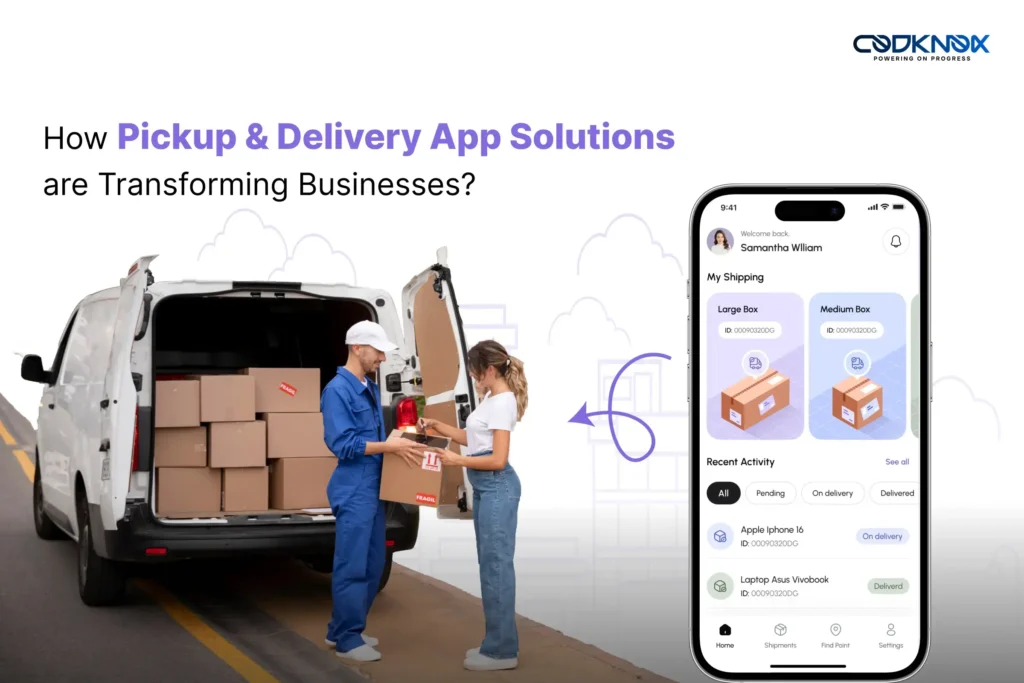
How Pickup & Delivery App Solutions Are Transforming Businesses?
In 2026, speed, convenience, and automation are no longer optional for businesses, they are expected. According to recent industry data, More than 72% of U.S. consumers prefer brands offering same-day pickup and delivery options. Moreover, it is seen that businesses using digital delivery platforms report 30-45% higher transaction completion rates. This has led to the fast pace of pickup and delivery app development, which help businesses generate more revenue and close more sales. Whether it is a food delivery application, salon, or pharmacy the on-demand pickup and delivery apps are becoming one of the popular apps among users. This is not only making the life of people easier but also allowing businesses to try their hands-on development of such apps. The Future of Pickup & Delivery App Solutions Automation, artificial intelligence, and smarter logistics are the new drivers of the future of pickup and delivery apps. Companies that have embraced the on-demand pickup and delivery app development are already experiencing reduced fulfillment cycle and an increased rate of success in transactions. Smart routing, autonomous delivery integrations, and predictive analytics, will continue to change the business operations of businesses in the next few years, making pickup and delivery app solutions a core revenue engine rather than a support tool. How do Pickup and Delivery Apps Work? Understanding how pickup and delivery apps work helps businesses make informed investment decisions. The process include: User Interface The app users can browse the variety of goods and services offered by various companies. They are able to see availability, prices and specifications of products. Order Placement Once they have selected and put the right products to their basket, they can check out. They provide the payment information and shipping. Matching Algorithm A complex matching algorithm operates in the background. It finds the closest delivery service that can quickly complete the request. Notification Data about the incoming order such as the address of the delivery and the information about the order is sent to the designated delivery service provider. Acceptance Or Rejection The order may be accepted or rejected by the delivery service. On acceptance, they visit the location of the company to collect the things. Real-Time Tracking The customers will be able to monitor their orders and their locations in real-time. This openness enhances the entire user experience. Delivery The goods are picked up from the company and delivered to the user’s designated location by the delivery service. To guarantee flawless travel, they could utilize the app’s GPS guidance feature. Payment Processing The payment is done through the app once the delivery has been completed, frequently utilizing safe online payment options. User Reviews And Ratings The customers can also give reviews and ratings on the service after delivery, a factor that helps in maintaining excellence standards. Read Also: How Much Does It Cost to Build a Pickup and Delivery App? Benefits of Pickup and Delivery App for Business The benefits of pickup and delivery apps for business go far beyond convenience. These platforms directly impact revenue, operational efficiency, and customer loyalty. 1. Increased Customer Convenience The custom pickup and delivery app allows customers to: Place orders at any time and from any place Track their orders Choose flexible payment options This makes the experience hassle-free for customers. 2. Expanded Market Reach The delivery service offered by the businesses will enable them to reach their customers beyond their geographical location. This helps attract more customers and compete effectively in their geographical area without having to establish new business storefronts. 3. Faster Deliveries A smart matching algorithm and the use of GPS route optimization assigns order to the delivery partners in the vicinity, shortening the distance employed in traveling and adding faster pickups and drop-offs, which leads to higher customer satisfaction. 4. Better Customer Insights The apps provide valuable information about customer behavior and the pattern of orders, thus enabling businesses to make informed decisions. 5. Higher Revenue & Brand Loyalty More convenient experiences, consistent delivery, and individualized experiences enhance customer satisfaction that leads to repurchase, high ratings, greater brand loyalty, and steady revenue increase. 6. Operational Efficiency The apps allow for automated order management, electronic payments, and delivery routes. This enables businesses to process more orders with fewer resources. Pickup and Delivery App for Small Businesses and Startups Local stores and startups can now compete with bigger brands by offering the same level of convenience. Pickup and delivery apps for small businesses have become a game-changer in this. A custom pickup and delivery app allows them to manage branding, pricing, and customer information without turning intensely to third-party platforms. For startups, these apps can help in quick market entry and quick generation of revenue. Online payment and automated order management enable the founders to focus on growth rather than logistics. Pickup and Delivery App for Restaurants and Retail The demand for pickup and delivery apps for restaurants and retail continues to grow. These apps enable restaurants to boost the rate of orders and decrease reliance on third-party marketplaces. Retailers use delivery applications to transform online shopping into made purchases in less time. A pickup and delivery app for startups also helps new businesses launch quickly, determine the demand, and get preliminary income without incurring massive infrastructure expenses. Cost of Pickup & Delivery App in USA The cost to build a pickup and delivery app in the USA is one of the most frequently asked questions. The cost of the pickup and delivery app development will rely on features, platform complexity, integrations, and the requirements of scalability. On average, the cost of a pickup & delivery app in the USA can range from $25,000 to $120,000+, depending on whether it is a basic MVP or a full-scale enterprise software solution. Investing money on a scalable pickup and delivery app solution in the USA will ensure a long-term ROI on investment. Why Choose a Custom Pickup & Delivery App? A white-label pickup and delivery app solution can be relatively cheap initially, but in many cases, the solution
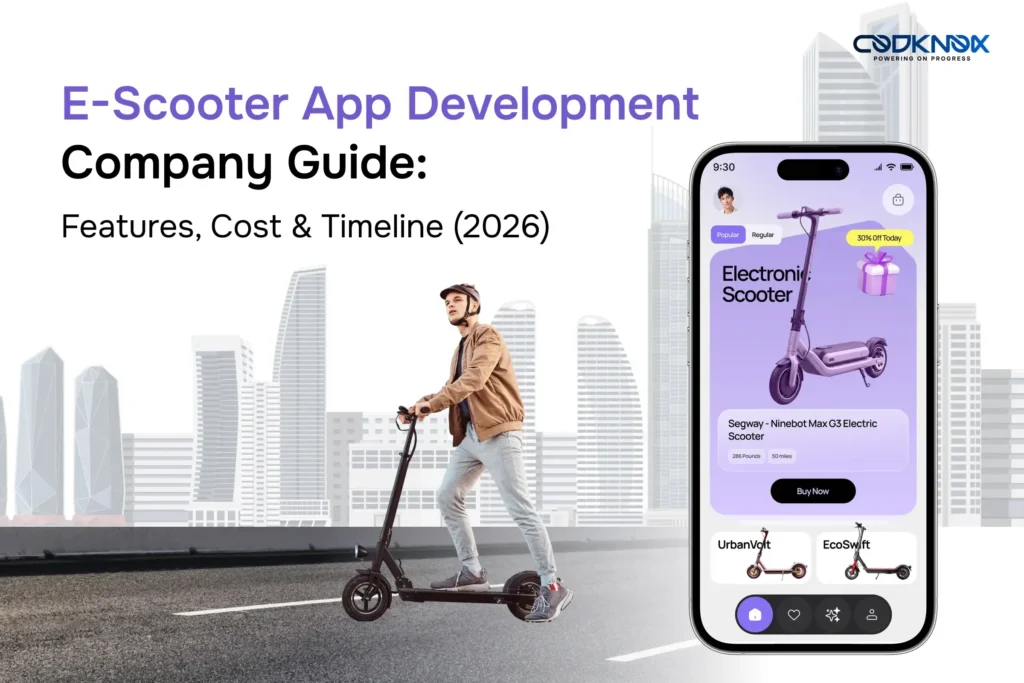
E-Scooter App Development Company Guide: Features, Cost & Timeline (2026)
E-scooters have become a trending urban transport choice for many youngsters and are seen as an appropriate solution for cities. In 2026, more cities are expected to adopt this sustainable and smarter mobility option. As there has been more demand for e-scooter mobile app development, more and more businesses are actively looking for ways to invest in the futuristic tech. This blog explores, features, cost, and timeline to create a fully functional e-scooter mobile app. E-Scooter Industry Facts and Statistics In 2019, the e-scooter industry was standing at $18.6 billion and is expected to reach $41.8 billion by 2030. In the USA, the e-scooter companies earned an amazing $255 million by renting electric scooters. China and India are two leading countries in the e-scooter demand, with over 80% of the market share due to affordable transportation requirements. Must-Have and Key Features of an E-Scooter Mobile App A well-built scooter app is the primary core of any successful rental service. Whether you are planning electric scooter app development, getting aware of the essential features helps you create an app that delivers value to consumers. Moreover, below we explain Five Must-Have Features and Five Key Features that every custom e-scooter mobile app should include. Must-Have Features These are the fundamental features without which your on-demand e-scooter app cannot function properly. In short, as a startup or an enterprise, you must include these features in your application. 1. User Registration and a Secure Login Users need to feel safe enough while registering via your app, which is only possible if you offer them a smooth onboarding process. Our team of expert iOS and Android app developers always gives emphasis on creating a process that is secure and error-free. Consumers should be able to sign up with the use of their email, phone number, or official social accounts. And this entire process must be done within 10 10-second timeframe, not more than that. For safety purposes, include a secure login with OTP (One-Time Password) and give the option to integrate two-factor authentication for users. This helps to protect user accounts and creates a sense of trust. 2. Real-Time E-Scooter Tracking and Map View E-scooter app users need to be able to view available scooters around them on a live map. This requires GPS integration and real-time tracking so that riders can find nearby scooters in an instant. Use the app to display distance from a user location, battery status of the e-scooter, and lock/unlock points. This is one of the most salient e-scooter app features for the majority of users’ convenience. 3. QR Code Scan to Start the Ride An easy and fast method to unlock scooters is via the use of QR code scanning. After a user finds a scooter, they must be able to scan the code and start the ride. This entire process should save users time and aim to remove manual input errors. 4. Secure In-App Payment Method Your e-scooter mobile app should support multiple payment options such as debit or credit cards, wallets, and net banking. Make sure that the payment gateway is secure and in accordance with the financial standards. App consumers should be able to view ride costs, bill invoices, and receipts easily. 5. Ride History and Invoices Every user should have access to their ride history. This includes dates, routes, duration, and charges. Offering downloadable invoices adds transparency and improves user confidence in your service. Key Features of an E-Scooter App Beyond the fundamentals, these features improve business management and user experience in general. 1. Push Alerts and Notifications Users are kept up to current on ride updates, promotions, safety advice, and payment reminders through timely alerts. These notifications lessen app abandonment and help sustain engagement. 2. Navigation within the App A built-in navigation tool directs users to the scooter or destination of their choice while real-time maps provide scooter locations. By integrating with well-known map services, riders may safely and swiftly reach their destination. 3. Safety and Ride Guidelines Safety is the most important aspect of an e-scooter app. It should have clear instructions on how to ride the scooter, helmet reminders, basic and key traffic rules, and emergency contact options. 4. Evaluations, Reviews, and Comments Transparency is increased when users may rate and comment on scooters. Operators might use this information to locate troublesome areas or cars that need maintenance. When users’ thoughts are valued, they feel heard. 5. Dashboard for Administrators and Operators In order to manage scooters, track rides, and analyze analytics, your company needs a dashboard behind the scenes. Operators can monitor revenue, maintenance plans, response teams, and usage trends with the aid of this service. It grows your company effectively and expertly. How Much Does it Cost to Develop an E-Scooter App? The cost to develop an e-scooter app relies on numerous factors, such as the app’s complexity, features, platform choice, and development team location, plus expertise. Furthermore, design quality, backend infrastructure, and third-party services. Startups and businesses must also keep post-launch services in mind while combining the total cost. To conclude, on average, the cost to build an e-scooter app can range from a basic investment to a higher budget for an enterprise-grade platform. However, to get a better understanding of how different factors decide the pricing, we have created the following cost table. Make sure to thoroughly check it. Timeline to Develop an E-Scooter Mobile App The e-scooter app development timeline depends on the app’s complexity, features, team expertise, and other factors. A basic app might take less time than a full-scale platform; on the other hand, an app with advanced features will require more time. On average, an e-scooter app takes 3 to 6 months to develop. 1. Planning and Discovery (2–3 Weeks) Market research, defining app goals, completing features, and choosing the appropriate technology stack are the main priorities of this stage. Later in the development process, delays can be avoided with careful planning. 2. UI/UX Design (three to four weeks) This stage includes wireframes,

AI in Real Estate: Top Use Cases & Emerging Trends
Artificial intelligence is transforming different industries globally, whether it’s real estate, healthcare, logistics, or travel. Its impact is known and is making the shift in the market, which is expected to touch $1.8 trillion by the end of 2030. When it comes to the real estate market, AI plays a major role. Several important roles depend on AI, such as rapid decision-making, user satisfaction, and business operations. With a compound annual growth rate (CAGR) of 35%, the AI in the real estate market is predicted by Maximize Market Research to reach US$1,335.89 billion by 2029, demonstrating the expanding influence of AI in the sector. In this blog, we’ll learn about the real use cases of AI in real estate and emerging trends. To better understand the expanding role of AI in the estate industry, we have created a latest statistics chart: AI Use Cases in Real Estate 1. Property Valuation To calculate precise and current valuations, Automated Valuation Models (AVMs) use data including market trends and the features of specific assets. AI in real estate also helps with market forecasts. Both real estate agents and investors looking for quality homes can benefit from this forecasting technique since every choice should be supported by thoroughly examined data. 2. Advanced Search AI-powered real estate apps with the integration of advanced search functionality are transforming the way buyers and renters discover available house listings. Unlike earlier, when realtors used to depend on basic filters such as price, location, and size. Nowadays, with the complete utilization of AI-driven search tools, user behavior, choice, pattern, and in some cases, subtle clues such as features and neighborhood style can also be taken into consideration. For instance, a user searching for “family-friendly neighborhood” might be shown a listing of places near schools and parks. These intelligent algorithms refine outcomes over time. The advanced search improves with every single interaction. By integrating advanced search into apps, realtors can engage potential clients, while users can enjoy a simple property search! This amazing innovation saves time and also increases the chances of finding a perfect match, making it a revolution for the industry. 3. Enhanced Personalization Another benefit of AI in real estate is enhanced personalization. Yes! When it comes to satisfying users, personalization takes the first seat. Driven by advanced AI algorithms, for personalized results, AI analyzes consumers’ behavior, preferences, and search history. As an outcome, users get highly relevant property suggestions instead of generic results. This approach makes every property search faster and much better. For example, renters can now get optimized suggestions for properties on the basis of budget, location, and lifestyle requirements. Real estate apps and platforms maintain user engagement, increase customer satisfaction, and promote repeat use by incorporating personalized features. In the highly competitive real estate market, this combination of AI-driven information and personalized experiences is starting to stand out. 4. AI Chatbots and Assistants AI chatbots are changing the way consumers are engaging in the real estate sector by offering 24/7 support to buyers, sellers, and renters. Chatbots remain active throughout the day and can answer queries related to property viewings, schedule, and offer updates on listings. By using this feature in real estate app development, these virtual assistants can access significant property databases, analyze client preferences, and provide tailored recommendations within a few seconds. 5. Document Processing Since contracts, leases, and title deeds all need to be carefully reviewed and organized, paperwork can be one of the time-consuming activities in the real estate industry. Document processing driven by AI relieves you of this effort by automatically extracting, validating, and classifying data in a matter of seconds. Transactions are expedited, human error is decreased, and all legal requirements are maintained. Document automation gives businesses that provide real estate app development services a significant edge by enabling customers to handle massive amounts of paperwork with ease. Agents and property managers can concentrate on what truly matters—creating relationships and closing deals—by reducing hours of manual labor to minutes. 6. Fraud Detection & Risk Analysis The value-based nature of the real estate transaction makes it vulnerable to fraud. Artificial intelligence helps to detect fraud and prevent loss. AI can recognize transaction patterns and suspicious activity that can be used to fabricate fake activity. This is used to prevent losses for real estate agents, purchasers, and sellers. Real estate app developers emphasize the use of this feature in mobile applications, as nowadays, with the advancement in technology, the chances of fraud have increased a great deal. 7. Creation of Property Description Perhaps the most well-known application of AI in real estate is this one. Rather than devoting hours to crafting descriptions for every attribute, you “feed” a GenAI tool all the essential details, such as Location, Exterior color, Price, Total number of rooms (residential or commercial), and so forth. In addition to this, you can specify the preferred material format, text length, and tone of voice. Because creating descriptions for tens or hundreds of properties is no longer difficult, this helps save time and money. However, there is an alternative method of producing descriptions that does not necessitate the creation of intricate prompts. Next, we talk about them. Real Estate Technology Trends 1. Virtual Tours Driven by AI By enabling purchasers to virtually tour properties using interactive, 360-degree images, virtual tours are revolutionizing the way that people perceive real estate. 2. Perspectives on Sustainability & Energy Efficiency Through the analysis of consumption trends and the recommendation of sustainable modifications, artificial intelligence (AI) real estate technology is facilitating more intelligent energy management in properties. 3. Smart Real Estate Development & City Planning The use of AI in property management is essential to the growth of smart cities. AI systems optimize traffic management, infrastructure planning, and zoning by utilizing large data. 4. Integration of Blockchain and Smart Contracts Blockchain-powered smart contracts are revolutionizing real estate transactions by automating and securing agreements without the need for middlemen. Ready to Develop a Real Estate Mobile App? If you are planning to